Archive for the ‘Art Activities’ Category

Unrolling Tie-Dye – Friday Art Group

Saturday, March 31st, 2012

There’s something magic about the exciting possibilities in a sink full of tie-dye you’re about to rinse out. What is it going to look like?

First the rubber bands (or hair ties if you are all out!) come off.

The gather stitching gets pulled out.

The pattern is revealed.

Then finally after washing and drying you get to see the colors that are left.

Should you wish to duplicate this, we used a basic shibori stitching and gathering technique, and Procion MX Fiber Reactive Cold Water Dye from Dharma Trading.

Do you think tie-dye is ‘so over’, or do you still love it? Personally, when I get a screen printed shirt from Threadless that just isn’t a good color on me, I crumple dye it, with a close family of colors, browns & rose, or blue & dark green, for that subtle (and HARD TO STAIN) color mash, with the cool Threadless graphic on top. I don’t wear rainbows much anymore, but I still wear tie dye. :-) Okay, actually, I still wear tie dye rainbows, what am I saying. How about you?

Spring Flower Fairies Tutorial (Friday Art Group)

Saturday, March 24th, 2012

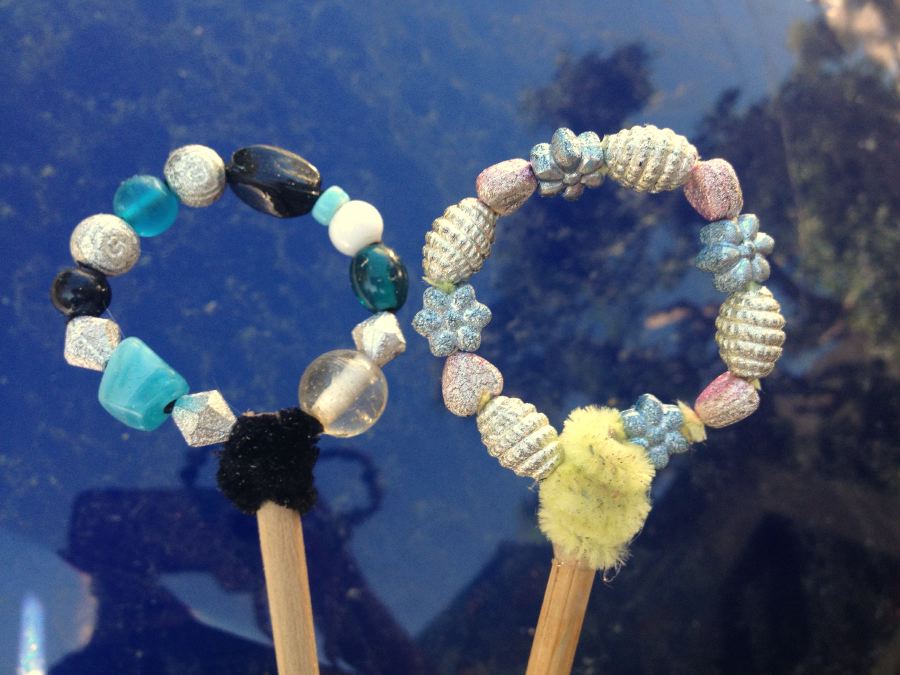
It was just the Spring Equinox! So we made fairies. We always make flower fairies, or something for them, like houses. This year we shared it with our art group. The moms had a great time making these flower fairies. The kids (5-6yrs) unfortunately just wanted to pick out the bits and have their moms put them together. Maybe I could have staged things better, I’m sure we will try again next spring, and I will try to lay things out so that the method is easier for little fingers.

What you need:

  • Silk scraps cut into flower shapes
  • Glass and/or wooden beads for bodies and heads.
  • Hemp beading coord
  • Fine gauge wire for homemade beading needle, or other needle
  • Pliers

You especially need the pliers if your doubled over cord is a tight fit for the glass beads. This is project is better for small hands if you use plastic pony beads, but I don’t like to buy plastic.

The flower cut outs were made by my new sizzix die-cutter-thingy. I used Tim Holtz’s Tattered Florals die. You can cut perfectly beautiful flowers by hand, but not enough for 9 kids and 5 moms without going crazy. So I finally broke down and got a die cutter, I have been wanting one for forever. Actually, I was NOT buying one yet again, and my husband took the computer and bought it for me. Awesome. Now I just have to figure out where to put it!

I am going to start out by sharing how to make your own beading needles for super cheap. Never be without the pesky useful things again! That is, as long as you have a spool of fine gauge wire. This is something higher than 30, I tried to measure it with our wire strippers, but that is as high as they go. Not much higher than 30, but a bit. 32-34 possibly. I don’t even know if you can buy wire like this anymore, I’m pretty sure it is older than I am and belonged to my grandmother. It’s been kicking around with my beading supplies for, probably about 25 years now, and has finally found its calling. Isn’t that a beautiful label though? I’m guessing it’s from post WWII Japan, 50′s or 60′s, and probably full of lead, but I’ll just keep it out of everyone’s mouth and pretend I didn’t think about that! Back on topic.

So, cut some fine gage wire twice the length you want your needle. Not plastic coated, not 49 strand super beading wire, just plain old bare drawn wire. Soft, not springy.

Grab the two ends together in the pliers, stick your finger through the loop and start twiddling your finger around like you’re absentmindedly twisting up your hair into dreads and driving your mother batty.

As it gets twisted up it should break right off. If it gets too tight before it breaks, try putting a pencil in (don’t garrote your finger!), or bending it back and forth without twisting. You want it to work harden and break off right where the pliers are holding it.

These are super useful (although softer than real beading needles which have been spring tempered), and what is semi critical for this project, expendable!

On to the fairies, nothing deep and mysterious here, I’m sure you can figure it out yourself, but here’s how we did it!

Start by laying out your bits. Flower cut outs for the skirt, a bead for the body, a bead for the head, and a small flower for the hat.

Cut a doubled layer of hemp cord and thread it onto your needle.

String up everything you laid out from bottom to top, without pushing it right off the end of your cord. If your fabric is too tightly woven for your homemade needle you may have to snip a tiny hole in the center. I found if I just carefully poked a couple times I could generally make it through. When everything is strung, tie a knot into the loop at the top. At this point you have two choices, you can cut the loop into antennas, freeing your needle, or you can untwist or cut your expendable needle. You may be able to twist it back up into another needle, but its life is certainly limited.

Push all the fairy bits up against the knot at the top, and tie a square knot under the bottom flower skirt to make hips and hold the whole thing together.

Tie overhand knots for feet, leaving enough string so the legs are just longer than the longest skirt. Cut the cord off below the feet.

Take a short length of cord and tie an overhand knot in-between the head bead and body bead. Then tie two more overhand knots for the hands and trim off the extra cord.

Then it is tea party time!

Silk Painting

Monday, March 19th, 2012

I’ve never painted silk before, and we was planning on doing it for Arts Focus, so I wanted a bit of a preview. (Before failing spectacularly with 25 kids I try to fail spectacularly with 3-6!) And fail I did, at least in my eyes if not theirs. We painted on our gutta – if you are familiar with glue-batik, this is the glue. It forms walls that the liquid watercolor like silk dyes won’t pass. So far so good. We waited for it to dry, some more patiently than others. We painted on the dye, and it did. not. flow. I got out the water spray bottles, and it sorta flowed. Because I hadn’t bought dye, I had bought Dye-Na-Flow silk paint, and the part of the advertising copy where it says ‘flows like dye’? Not so much. It is a highly pigmented and watered down acrylic paint, and that is what it acted like. It left a thin plastic layer on top of the silk, which after it dries you can scrub off like paint. Maybe it would have behaved a little better if I had heat set it like one of our members did, but I was lost at the ‘doesn’t flow’ point.

Look at this brilliant piece by one of my students. In class we used Jaquard Green Label dyes, also from Dharma Trading (who I love, they are so nice), which amazingly enough acted like DYES! Shocking. I had avoided the dyes because you have to either steam them or use a chemical fixer to set them, and I didn’t want to set up a steamer (ironing is apparently insufficient) and try to keep things as non-toxic as possible and I was a little unsure about the fixer. But in class given our furious schedule, and the fact that we had already inherited the fixer, after hours of research the night before that was the route I took. And it wasn’t a disaster! Yay! We did the gutta the week before, so I had sets of 8 kids coming and painting their silk hoops, putting them over in the drying rack and going at them with a hair dryer, painting dyeset on with a brush, and then putting it back in the rack to dry. Then I waited a few minutes, rinsed them and set them to soak in a tub, to get the gutta off, while the next set of kids started in on the painting. (We had three projects going round-robin.) Luckily since it was the last session of Arts Focus everyone went to see the Performing Arts group’s performance for the last half hour, and I just had time to scrub and dry everything. I could have sent them home with resist on their work, but I wasn’t sure that they would get finished, and they were so beautiful with the lumpy gutta scrubbed off it was worth the extra work.

What did I learn? Acrylic paint is not dye. I can be such a sucker.

If you have older kids I really recommend trying out the Jaquard starter set (water based!), with some scarves or pre-stretched hoops, it is such an amazingly beautiful project! Even if you just draw some squares and circles together, the way the colors fill in the shapes and shine is just gorgeous. We used these dyes on an unstretched scarf too, just painted them on with no resist (that student had missed the previous class) and that was beautiful too. I think next time we need presents for the grandmothers we are going to get out silk painting and scarves.

Accordion Books – Friday Art Group

Friday, March 16th, 2012

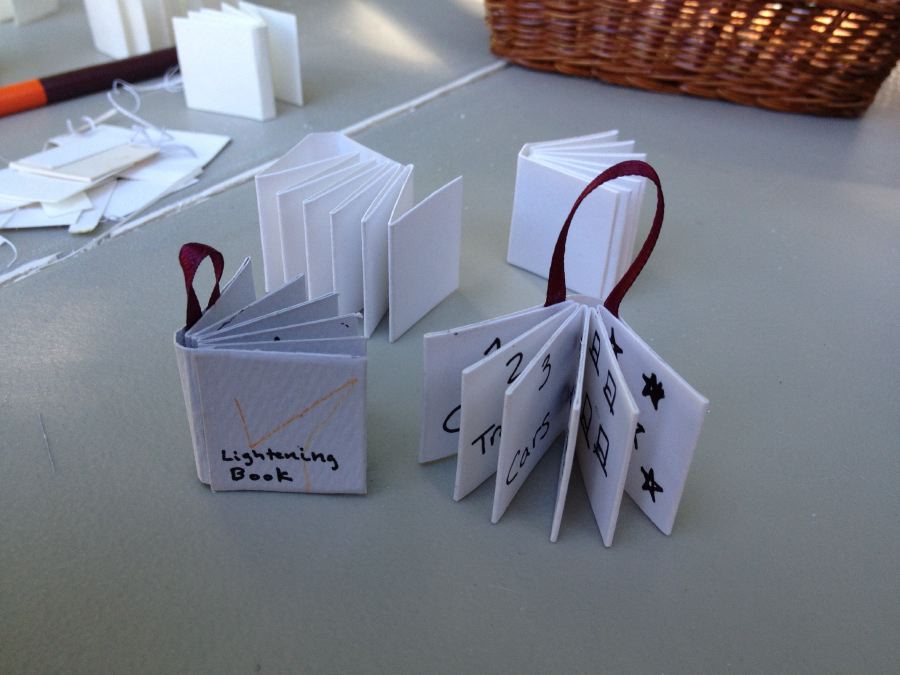
We love making books around here. Rebecca has been making a ton of those little books where you fold the paper into 8 sections (three folds) and cut through the middle then fold it flat. Susan Gaylord has a great page on making books with kids, and she calls these ‘hot dog booklets‘, which isn’t a very inspiring name. We call them magic fold books, at least I think we do! But no one else seems to. Where was I? Oh. Accordion books!

The basic idea is to cut a long strip of paper, we have lots of 12″x18″ paper, so I cut 2″x18″ strips, then fold them back and forth into an accordion, and glue two little squares of cerial box cardboard onto the ends. Done! Yes, Susan Gaylord has a page on accordion books too. She also has a lovely blog, and here is everything labeled accordion books!

I recently (actually before Arts Focus started, so I’d almost completely forgotten about it!) bought Making Books That Fly, Fold, Wrap, Hide, Pop Up, Twist & Turn which has a heap of nifty books, now that I’ve just finished teaching this session of Arts Focus (although my brain is still there!) maybe I will be able to share some of the ideas in there with Rebecca. And thus you!

What kinds of books do you and your children enjoy making?

Leprechaun Door Sorta Tutorial

Sunday, March 11th, 2012

One more week of teaching Arts Focus, and I’ve taken a contract at work. So much going on that I’m starting to need to write things down, I’m pretty sure I have more projects going than I can even remember I’m working on at one time! But Friday Art Playgroup must go on!

This week we made leprechaun doors, since St. Patrick’s Day is coming up. Last year at Rebecca’s preschool they made leprechaun traps, which I think is a little bit awful. So I’ve tried to encourage an alternate mythology. On St. Patrick’s Day all the leprechaun’s come out to go house hunting, the young ones getting kicked out of their parents house, the empty nesters looking for smaller digs, time to shop around for a new pad. And if they see you’ve tried to make them a nice place, they may leave you some chocolate coins or jewels in appreciation. So we make leprechaun beds and hidey holes. But given Irish leprechaun lore of trickery and mayhem, perhaps traps are more appropriate.


For this project I put out lots of materials, sticks, popsicle sticks, toothpicks (actually one of the kids found those in the glue box, more power to them!), hot glue, masking tape, string, buttons & glitter glue. I stuck with sticks and string.

For my version of a door, start by sharpening two side posts (so you can push the door into the ground easily), and then lash four sticks together into a door frame. If you don’t know much about square lashing, I recommend How To Lash Two Sticks Together – Part 1 and How To Lash Two Sticks Together – Part 2, or you can just google ‘square lashing’.


Lash a raft of sticks together, leaving an inch of the cross pieces sticking out on one side, and loosely lash those onto your door frame.

Then, stick it into the ground. Not much of a tutorial, but I’m really supposed to be researching feature detection & tracking with OpenCV right now…

See, it opens! At least for a little while until the cotton string fatigues. Then I can tie it on with elastic or something. Which might last a couple months, and then I will… Get out the sculpture wire. That sounds like a better solution!

I love lashing. I may have neglected actually running the playgroup and concentrated entirely on my project. I can be a bit obsessive that way! What was the last thing you made out of sticks?

Hot Rocks & Crayons

Sunday, February 26th, 2012

This is a most excellent project that we did in April of last year, but slipped through the posting cracks. And as I am in the throws of teaching Arts Focus I’m forgetting to even photograph our current Friday Art Playgroups!

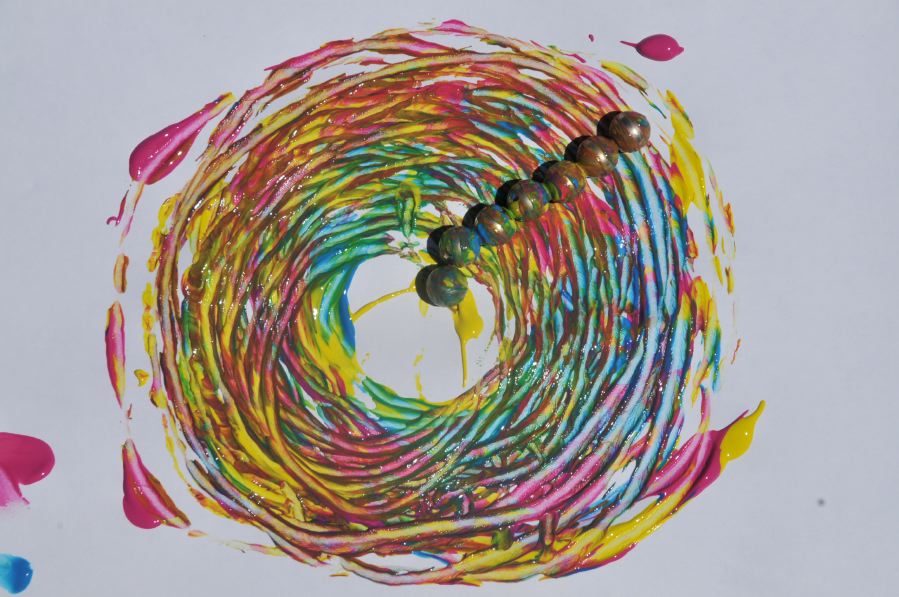
Melting the crayons on the hot rocks is absolutely addictive and wonderful and tactile and drippy and amazing.

Great directions at 5 Orange Potatoes, I feel no need to write my own.

I am thinking about adapting this to Easter eggs, but blown they wouldn’t hold the heat to melt crayons on (and not blown they don’t last long). But we’ve learned that you can put crayons into a glue gun, so I’m thinking blown eggs + crayons in glue gun. Yes? And then perhaps over dyeing? Oh, and glitter into the melted crayon? What was your favorite egg craft from last year? What, it’s still February? I guess I’m getting ahead of myself…