Archive for the ‘Crafty’ Category

The Oc-Toy-Put Revealed

Monday, May 14th, 2012

Oc-Toy-Put or Oct-Toy-Put? Opinions? I was originally going to call it something boring and factual – Octopus Animal Organizer – I guess I try to cram everything into a name that I think someone might want to know. But my friend John came up with this catchier name. (It’s catchier, right?) In case you can’t tell, you hang it up and it lovingly strangles, or, um, hugs, 8 of your other stuffed animals. If you’ve already lovingly made your children too many stuffies, here is your guilt free opportunity to make another one! Or at least it was for me…

Squeezed into one yard of fabric, (barely, I’m all about the barely), for the next One Yard Wonders book. Props to maryanne for guessing that the pic of the pattern sketch in the post-before-last was an octopus!

Penelope loves her new octopus, and was a very patient little model, even when it was eating her.

Frosting?

Thursday, May 10th, 2012

If this were a piece of cake which one would look the most like frosting? Sometimes a pattern is simple and obvious for me, and sometimes, especially when I am concentrating on making something ‘easy’, trying to come up with a pattern that I think someone else can duplicate, it can take me a long time to get something right. This is probably a record for prototypes, and I think I’ve lost a few. The last one clockwise is a little unbalanced, the top curve is leaning over to the side, but I know how to fix that, so my current favorite is the second from the clockwise end. I really had a lot of hope for the one with lace, but when it was done, bleh. The gathered ones are okay in some ways, (4,5 & 6 clockwise) but I don’t feel like their structurally sound, since if the gather thread snaps they will pop out. I’m thinking, maybe pin tucks? Or possibly this is all the Resistance.

What is Going On?

Sunday, April 22nd, 2012

Don’t I love you anymore? Yes, of course I do, even my own children have been wondering that at times though, it has been a rough several weeks. Funny, one of those was a vacation, but road tripping to San Diego by myself with two girls was a lot of work. I was pretty much ‘on’ the whole time and didn’t even manage to catch up on my sleep, what’s up with that?! We did see LegoLand though, and that was pretty awesome, and did a lot of visiting. And a LOT of driving. Work has also been totally stressing me out. I generally haven’t been working (for pay that is!), but I am still ‘employed’ and every once in a while I take a contract through my company. Which means suddenly inventing more hours in the day, getting less sleep, falling behind on the house and all of the things that I do to make everyone’s life run smoothly. Because there really aren’t any extra hours in my day, they all have to come out of something important, don’t they? But it is good for my long term career, and often fun, although this particular project has turned out to be the not so fun kind. Can’t win them all. And once I am done inventing time for my paid work, I am now behind on two more promised projects for the next One Yard Wonders book. Which is much more fun, but still time consuming.

Want to guess what this one is? It’s done, so if you’ve seen it, or are secretly stalking me on FaceBook, no fair!

This post runs dangerously close to violating my blogging without obligation commitment, doesn’t it? Maybe I should take that down, I think I have made a commitment, and I do feel an obligation. But perhaps that’s silly. Doesn’t everyone use a blog reader now? So who cares when anyone updates, your reader is always full of 500 posts anyway? My mother-in-law was just complaining that there is no RSS button on my blog. I suppose my layout probably needs some love, but that will happen sometime in the next century, when I am DEAD and have lots of time! Sigh. I could get into blogging from the afterlife. I always did like Dar William’s Alleluia. See, I am sleep deprived and RANTING! Are you getting enough sleep? So that’s two questions for you, are you getting enough sleep, and what is that thing? Three: do you care if the blogs you read update regularly? (And do you hate it as much as I do when every post is apologizing for how they haven’t posted recently? (FOUR!)) Also I just realized I only have a month until Rebecca’s birthday! OMG.

Spring Flower Fairies Tutorial (Friday Art Group)

Saturday, March 24th, 2012

It was just the Spring Equinox! So we made fairies. We always make flower fairies, or something for them, like houses. This year we shared it with our art group. The moms had a great time making these flower fairies. The kids (5-6yrs) unfortunately just wanted to pick out the bits and have their moms put them together. Maybe I could have staged things better, I’m sure we will try again next spring, and I will try to lay things out so that the method is easier for little fingers.

What you need:

  • Silk scraps cut into flower shapes
  • Glass and/or wooden beads for bodies and heads.
  • Hemp beading coord
  • Fine gauge wire for homemade beading needle, or other needle
  • Pliers

You especially need the pliers if your doubled over cord is a tight fit for the glass beads. This is project is better for small hands if you use plastic pony beads, but I don’t like to buy plastic.

The flower cut outs were made by my new sizzix die-cutter-thingy. I used Tim Holtz’s Tattered Florals die. You can cut perfectly beautiful flowers by hand, but not enough for 9 kids and 5 moms without going crazy. So I finally broke down and got a die cutter, I have been wanting one for forever. Actually, I was NOT buying one yet again, and my husband took the computer and bought it for me. Awesome. Now I just have to figure out where to put it!

I am going to start out by sharing how to make your own beading needles for super cheap. Never be without the pesky useful things again! That is, as long as you have a spool of fine gauge wire. This is something higher than 30, I tried to measure it with our wire strippers, but that is as high as they go. Not much higher than 30, but a bit. 32-34 possibly. I don’t even know if you can buy wire like this anymore, I’m pretty sure it is older than I am and belonged to my grandmother. It’s been kicking around with my beading supplies for, probably about 25 years now, and has finally found its calling. Isn’t that a beautiful label though? I’m guessing it’s from post WWII Japan, 50′s or 60′s, and probably full of lead, but I’ll just keep it out of everyone’s mouth and pretend I didn’t think about that! Back on topic.

So, cut some fine gage wire twice the length you want your needle. Not plastic coated, not 49 strand super beading wire, just plain old bare drawn wire. Soft, not springy.

Grab the two ends together in the pliers, stick your finger through the loop and start twiddling your finger around like you’re absentmindedly twisting up your hair into dreads and driving your mother batty.

As it gets twisted up it should break right off. If it gets too tight before it breaks, try putting a pencil in (don’t garrote your finger!), or bending it back and forth without twisting. You want it to work harden and break off right where the pliers are holding it.

These are super useful (although softer than real beading needles which have been spring tempered), and what is semi critical for this project, expendable!

On to the fairies, nothing deep and mysterious here, I’m sure you can figure it out yourself, but here’s how we did it!

Start by laying out your bits. Flower cut outs for the skirt, a bead for the body, a bead for the head, and a small flower for the hat.

Cut a doubled layer of hemp cord and thread it onto your needle.

String up everything you laid out from bottom to top, without pushing it right off the end of your cord. If your fabric is too tightly woven for your homemade needle you may have to snip a tiny hole in the center. I found if I just carefully poked a couple times I could generally make it through. When everything is strung, tie a knot into the loop at the top. At this point you have two choices, you can cut the loop into antennas, freeing your needle, or you can untwist or cut your expendable needle. You may be able to twist it back up into another needle, but its life is certainly limited.

Push all the fairy bits up against the knot at the top, and tie a square knot under the bottom flower skirt to make hips and hold the whole thing together.

Tie overhand knots for feet, leaving enough string so the legs are just longer than the longest skirt. Cut the cord off below the feet.

Take a short length of cord and tie an overhand knot in-between the head bead and body bead. Then tie two more overhand knots for the hands and trim off the extra cord.

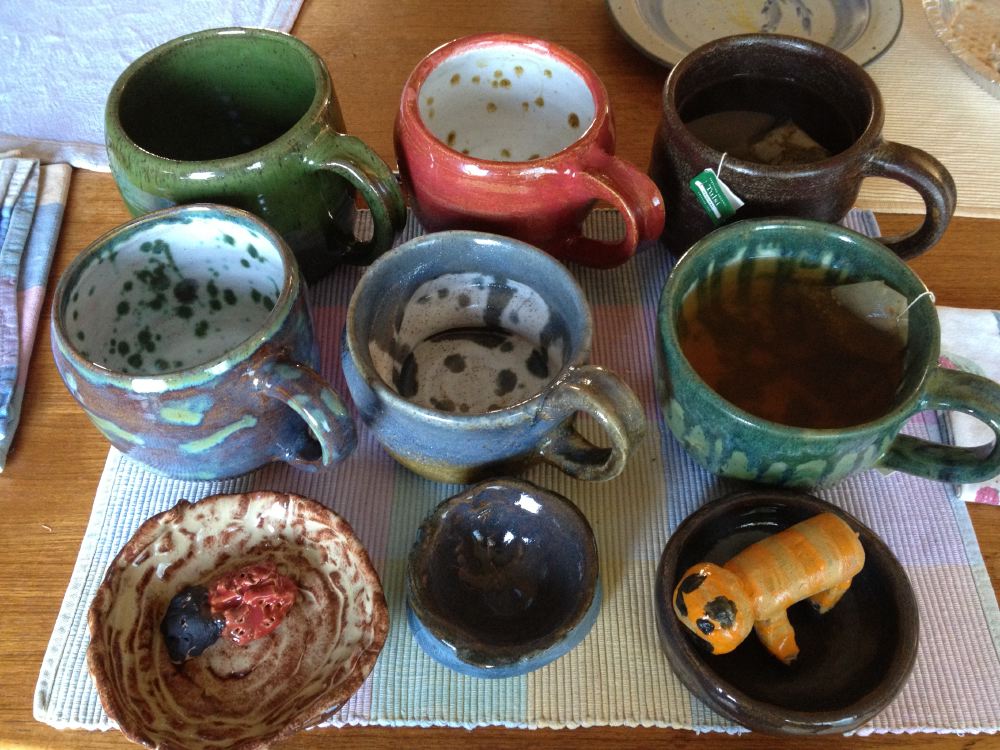
Then it is tea party time!

Fiber & Dyeing Research

Sunday, March 4th, 2012

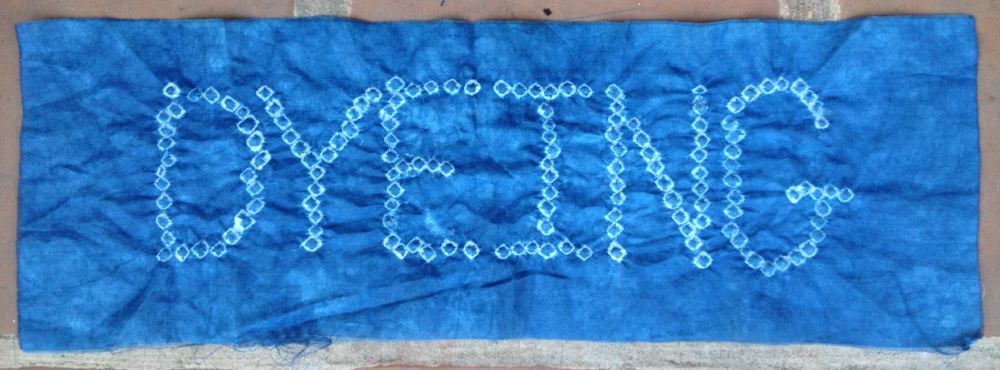
I have a mini obsession going right now, researching growing cotton & flax for my fiber class, and now I’ve branched into dye plants, wouldn’t it be great to bring in plants for the kids to use on their hand spun wool? I just need to figure out how it all works, and I’m always happiest when I’m learning things! And I’ve been learning some funny things reading Rita Buchanan’s A Weaver’s Garden which I found at the library.

Regarding the history of cotton (which as far as the Old World is concerned originated in India, but in the New World has apparently been independently cultivated from “Peru to Arizona” since prehistoric times along with New World spindles and looms predating European explorers):

Long ago, the amazing appearance of cotton was explained by the myth of the “Scythian lamb”. Medieval Europeans recited fantastic tales about the mysterious East. One story told of a tree or shrub that grew tiny lambs instead of flowers. Each lamb would bend ever on its stalk to browse on the nearby foliage, eat all the leaves within reach, and then wither away. The pure white fleeces of the lambs were “vegetable wool” or cotton bolls.

Isn’t that a fabulous image? I’m looking forward to growing miniature sheep in my garden this summer.

Flax: The flax species grown for seed and oil is the same, but it is harvested before the seeds set for fiber use. The awesome bit is the name, Linum usitatissimum, that’s Latin for “the most useful kind of flax.” (via The Herb Companion which has back yard flax growing and processing instructions.) [edit: I just realized this article is also written by Rita Buchanan which is wonderfully coincidental, but not surprising I guess.]

Indigo:
Indigo doesn’t chemically bond to fibers, it only adheres to them. It is a pigment, not a dye at all. Bluejeans are dyed (painted?) with indigo, and they become paler through rubbing off the indigo dye, not through fading via sunlight as many natural dyes do.

The chemistry of indigo is pretty cool too, you should read her book to find more out about it, but one thing I thought was neat: You get indoxl (C8H7NO) from soaking the leaves in water, which it isn’t soluble with, so it will precipitate out to the bottom. I think it is whitish or yellowish depending on the pH of the water. What it wants for its reaction into indigo is oxygen, so if you dip yarn into the water, and pull it out into the air (or churn the water) the indoxl coating the yarn will grab some oxygen, two indoxl molecules combine, loose 4 hydrogen, and produce indigo and water, and suddenly your yarn is blue. C8H7NO * 2 + O2 = C16H12N2O2 + H2O. (Disclaimer, I dropped out of AP Chem in high school and never looked back!) Rita’s description in A Weaver’s Garden (Google Books) is much more involved and I encourage you to read it if you are interested.

For the curious, here are the (less toxic) dye plants I’m now planning on (trying) growing (I’m also planning on harvesting nuts and tree woods locally):

  • Coreopsis / Cosmos (Yellow to Orange)
  • Dyer’s Broom (Yellow)
  • Madder (Red)
  • Weld (Yellow)
  • Indigo (Blue)
  • Woad (Blue)

Most of which it looks like I can get from HerbalHut (never tried them before). I got some Pima cotton seeds from Mielke’s Fiber Arts (Who I like) and I finally found some Linum usitatissimum at SeedCorner.com, we’ll see how that works out. I’ve listed these sources because I know you want to grow your own yarn too! Don’t you? I think growing cotton in the backyard is such an awesome educational project, whether you do anything other than play with the bolls or not.

Have you ever grown fiber or dye plants?

Rose Wand Tutorial

Sunday, January 22nd, 2012

Here is another never posted project from 2010, a rose wand, complete with a photo tutorial for the intrepid to follow.

As always, when making something, start by observing the original.

And then dissect it and over analyze it in as OCD a manner as possible. The Magenta petals are all the petals from a single rose, along with their position number with #1 being the most exterior petal, and #18 the innermost. The more purple petals are single petals from other roses annotated with the number of petals that that rose had. I think. It was a year and a half ago. I wanted to collect more samples, but my schedule (required for Halloween of 2010 I think), trumped my OCD desires.

Then summarize your findings.

And here is a PDF for printing:Labeled Petal Shapes Hopefully that comes out at the right scale, the petals should be roughly an inch and a half tall I think.


And finally construct a model.

On to the tutorial. Which is really just me looking at my step by step photos from a year and a half ago and guessing what I meant by them. Woo! I feel like such a consummate professional, but I feel like this little flower wand deserves to get out into the world, and this is the only way it is likely to happen!

    For the wand you will need:

  • About a foot of dowel painted green and the means to drill a hole in the end
  • A green pipe cleaner
  • Some green, yellow and rose colored felts
  • Matching rosy floss
  • A sprinkle of seed beads
  • A profusion of ribbons

Cut out your bits, one green star shape for the bottom, a yellow circle for the center, whose real purpose is to give you something to sew the petals onto, and some number of petals. For this rose I made three each of the inner, middle and outer petals, in two shades of rose. If I were going to do it again I’d probably use at least 5 for each ring. Or doubled the number of rings. Unfortunately you’re on your own for the exact size/shape of the sepals (the green bit at the base) unless you want to trace this jpg. Wing them and they will come out beautifully! Every flower is different after all.

Where the petals are split at the base (or all along the mid line) whip them together with matching floss and finger press the seam open flat. These are basically darts that give the petal a lovely curve. Duplicating that curve was the main goal of my slicing so many of them open. I’m not sure I quite got it, but then you can’t really perfectly duplicate a rose petals curve with just one dart.

Tart up that little yellow circle with seed beads, so it looks more like the stamen cluster it is meant to be.

Sew the inner petals too the back of the stamen cluster. Try to make your stitches invisible from the front. And use more petals than I did. (^_^)

You know what comes next. Sew on the middle petals underneath the inner petals, trying to offset them artistically. Or exactly in-between like an engineer. I’m not admitting anything! I also think a glue gun would be a great alternative here. d(-_^) (Thumbs up if you aren’t used to Asian smileys.)

Then sew on the outer petals. Same deal.

Right about now you may be feeling that your rose looks a bit wilty, all your petals passed out in a little circle, flat on their backs. I know I was. So squint at this picture, or better yet click through to the higher res one. Cheat. Okay, there is no cheating. Get creative, and tack your inner petals together. This will make the inside perk up into a more blown bud type of shape. The exact overlap you use will depend on the number of petals you are trying to fit in. Maybe you want to keep the rings of three petals and just make 6 tiers, whatever, it will be beautiful, because we started with a real rose! I am a true believer. Also, if you go to Google images and look at pictures of roses, there is a mad variety of flower and petal shapes. I, ahem, don’t even know what kind of rose I started with. The neighbors rose. Which I stole. Good thing they like me.

Moving on to those sepals. If you are making a flower wand for the kind of fairy who likes to bash everything in sight with said wand, you will want to reinforce your sepals, or they will get torn off. So I took a running stitch all the way around the edge. Maybe it would have been fine either way, but these sepals (this collective sepals shape, I am running out of good grammar), are going to be the connecting point between the rose and the wand. So reinforce it. Probably a good idea. Or, you know, go with the glue gun plan and don’t worry about a thing! d(^_^)b (I should obviously be in bed.)

Next up, fold your pipe cleaner in half, and cut two tiny tiny little holes in your sepals, and cram that green pipe cleaner through.

Now sew the sepals onto the base of the rose. I assume I sewed it. Oh yah, looking at the very fullest resolution picture I can see tiny green running stitches going around in a circle around the pipe cleaner. I probably went around a couple times, filling in between the first row of stitches, since it is hard to get your stitches very close together in thick close quarters like that. Or, uh, that glue gun. Do they sell glitter glue sticks yet? This would totally be an application for glittery glue sticks. I’ve seen glow in the dark glue sticks, if they don’t have glitter ones yet Martha should get on that.

This unnecessary picture shows the hole in the end of your painted green dowel. I think it is a 1/4″ dowel. But you might want to go beefier depending on the age of your recipient, ours broke several times before I pointed out, after re-glueing it repeatedly, that fairies did not actually BASH things with their wands. Deaf ears.

What this picture is, sadly, NOT showing you, is: stick both ends of the pipe cleaner through the hole at the end of the dowel in opposite directions, and pull it until there is a small open loop of pipe cleaner left, through which you can stick the profusion of ribbons. Since our wands don’t actually emit fairy dust we make due with shimmying ribbons. Then pull the pipe cleaner ends until everything is tight.

Now at this point if you pulled on the ribbons they would slip out. So lets fix that. Tie each of the ribbons in a knot, some on one side of the dowel, and some on the other, balancing things out.

Finally lets take care of that pipe cleaner. Knot and twist it around the stem, under the ribbons.

Pinch the ends double so they don’t poke anyone and/or tuck them away.

Frolic!!!

She hardly looks like she’s about to start bashing her sister over the head with that thing, does she? With the best of intentions of course…

I’m going to bed, let me know if I messed anything up too badly.

And let me know while you’re at it, do you like to dissect things to figure out how they are put together? Ever cut anything really cool up?