Posts Tagged ‘paint’

Silk Painting

Monday, March 19th, 2012

I’ve never painted silk before, and we was planning on doing it for Arts Focus, so I wanted a bit of a preview. (Before failing spectacularly with 25 kids I try to fail spectacularly with 3-6!) And fail I did, at least in my eyes if not theirs. We painted on our gutta – if you are familiar with glue-batik, this is the glue. It forms walls that the liquid watercolor like silk dyes won’t pass. So far so good. We waited for it to dry, some more patiently than others. We painted on the dye, and it did. not. flow. I got out the water spray bottles, and it sorta flowed. Because I hadn’t bought dye, I had bought Dye-Na-Flow silk paint, and the part of the advertising copy where it says ‘flows like dye’? Not so much. It is a highly pigmented and watered down acrylic paint, and that is what it acted like. It left a thin plastic layer on top of the silk, which after it dries you can scrub off like paint. Maybe it would have behaved a little better if I had heat set it like one of our members did, but I was lost at the ‘doesn’t flow’ point.

Look at this brilliant piece by one of my students. In class we used Jaquard Green Label dyes, also from Dharma Trading (who I love, they are so nice), which amazingly enough acted like DYES! Shocking. I had avoided the dyes because you have to either steam them or use a chemical fixer to set them, and I didn’t want to set up a steamer (ironing is apparently insufficient) and try to keep things as non-toxic as possible and I was a little unsure about the fixer. But in class given our furious schedule, and the fact that we had already inherited the fixer, after hours of research the night before that was the route I took. And it wasn’t a disaster! Yay! We did the gutta the week before, so I had sets of 8 kids coming and painting their silk hoops, putting them over in the drying rack and going at them with a hair dryer, painting dyeset on with a brush, and then putting it back in the rack to dry. Then I waited a few minutes, rinsed them and set them to soak in a tub, to get the gutta off, while the next set of kids started in on the painting. (We had three projects going round-robin.) Luckily since it was the last session of Arts Focus everyone went to see the Performing Arts group’s performance for the last half hour, and I just had time to scrub and dry everything. I could have sent them home with resist on their work, but I wasn’t sure that they would get finished, and they were so beautiful with the lumpy gutta scrubbed off it was worth the extra work.

What did I learn? Acrylic paint is not dye. I can be such a sucker.

If you have older kids I really recommend trying out the Jaquard starter set (water based!), with some scarves or pre-stretched hoops, it is such an amazingly beautiful project! Even if you just draw some squares and circles together, the way the colors fill in the shapes and shine is just gorgeous. We used these dyes on an unstretched scarf too, just painted them on with no resist (that student had missed the previous class) and that was beautiful too. I think next time we need presents for the grandmothers we are going to get out silk painting and scarves.

Color Mixing

Sunday, February 12th, 2012

This is a project I’ve been doing with Penelope (2). Give them two primary colors and let them go.

We’ve finished all three sets now, yellow/cyan, cyan/magenta, and magenta/yellow.

She likes all the little paint holes filled, and it gives more chances to mix up the true colors.

A pet peeve, although the three primaries are supposedly red, yellow and blue, with paint they are really the specific red yellow and blue of magenta, yellow and cyan (turquoise). Red and orange can both be mixed from magenta and yellow, but if you’ve tried to mix a really vibrant orange from red and yellow, it’s only sorta satisfying, and if you are trying to mix green, royal blue and yellow are totally unsatisfactory and give you a sort of washed out forest-y sort of green, whereas with cyan and yellow you can get a nice bright green. And yet, when you buy kids paint in ‘primaries’ you get the not so useful fire truck red, royal blue, and yellow. Why do you think printer ink comes in cyan, magenta, yellow and black? Yah. /rant.

Next up we will work on tints and shades. Yah, I’ve been re-reading Young at Art by Susan Striker.

Also, can you tell that I’m teaching Arts Focus at Rebecca’s school again? Things will be back to normal in a few more weeks.

Painting a Cardboard Fortress

Friday, January 6th, 2012

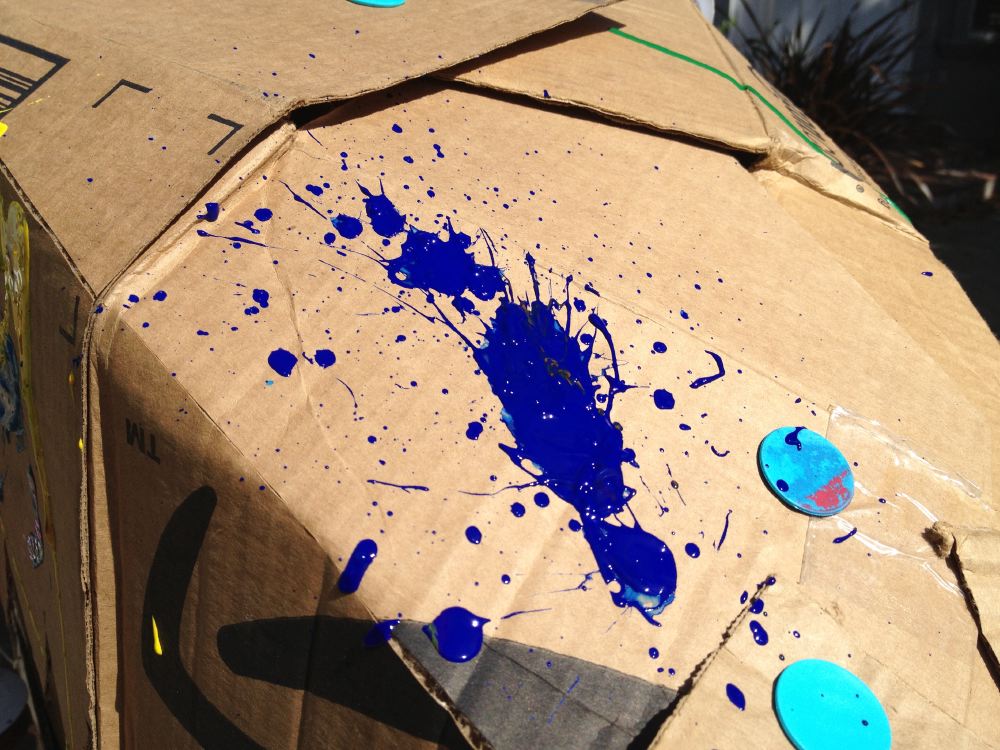
This was fun. Why paint one cardboard box when you can paint about 15 of them all riveted together with makedo? This fortress should have been more spectacular, but it and our entire cardboard stash was rained on the day before. Sad! Shoring up a damp wilted cardboard fortress with more soft cardboard doesn’t work so well. But it did help. The broom holding up the center helped more. Embarrassing, but practical.

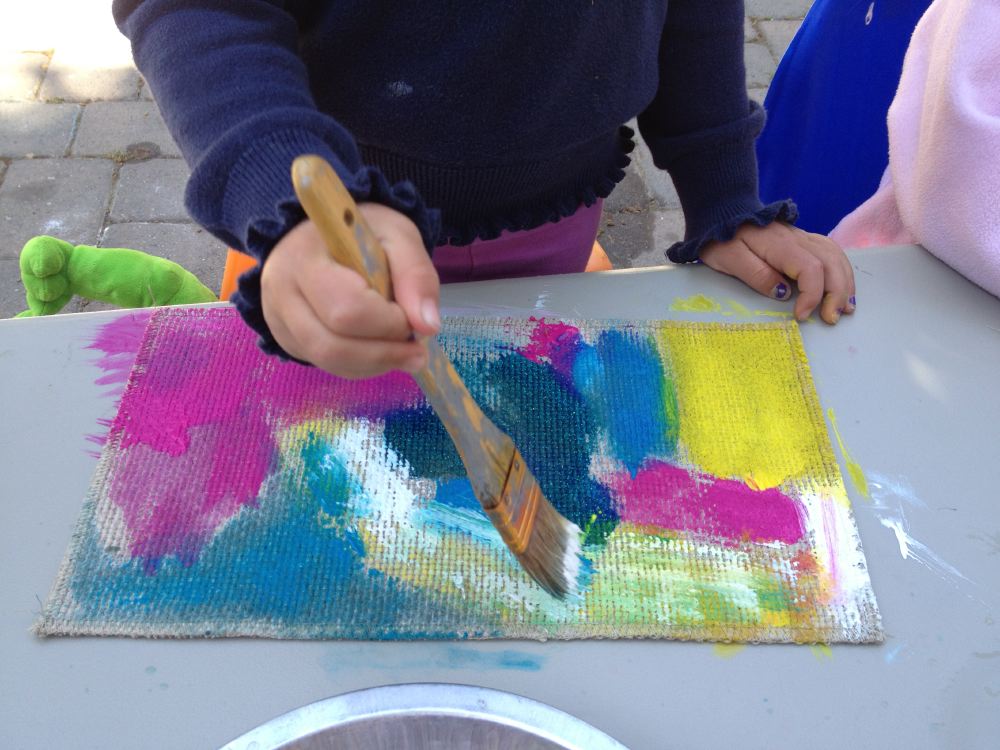
The girls really did love it. I put out tempera paint in pie pans, then water color spray bottles, and paper + masking tape. They painted and argued and painted, and worked on learning to spray paint their names. I felt like I was educating the next generation of taggers. One day cardboard buildings & spray bottles, the next underpasses and spray paint.

What did you do with all of your holiday cardboard?

Acrylic Stamping on Fabric

Tuesday, December 20th, 2011

One of the projects we did for my textiles class was stamping on canvas bags. Before that class I made this example piece of stamping a leaf and custom sponge stamp. Stamping with leaves is so much fun! I put a bit of acrylic paint into a baking tin, brushed it think with a brush, then rubbed the leaf in it. That kept the paint mainly on the leaves’ rib and veins which let me get a good print. I didn’t even have to use a brayer, I just pressed down evenly with my fingers. I was surprised that it worked as well as it did with as little fuss.

One of the other things I tested for my class is cutting sponge stamps, but I wanted something light enough that little hands with little scissors could cut it. I found these lightweight sponge-cloths, and they worked pretty well. They are about 3/16″ thick and pre-moisened, so they are soft. They are a little fiddly to stamp with, because they are thin, but they are nice to cut stamps out of and worked fine with just a smear of paint on my tray. After stamping the tree branches I went back later and drybrushed in the foliage.

Here are some of the kid’s bags, in addition to leaves and sponges they had pre-cut potato stamps, lemon and apple halves, pine cones and other fall detritus, and of course, their hands.

Snap Painting

Saturday, October 8th, 2011

I’ve seen Snap Painting a couple of places, one was on Teacher Tom’s blog (which is awesome, I totally need to redo my sidebar, it’s about a year out of date at least, sorry awesome bloggy friends!)

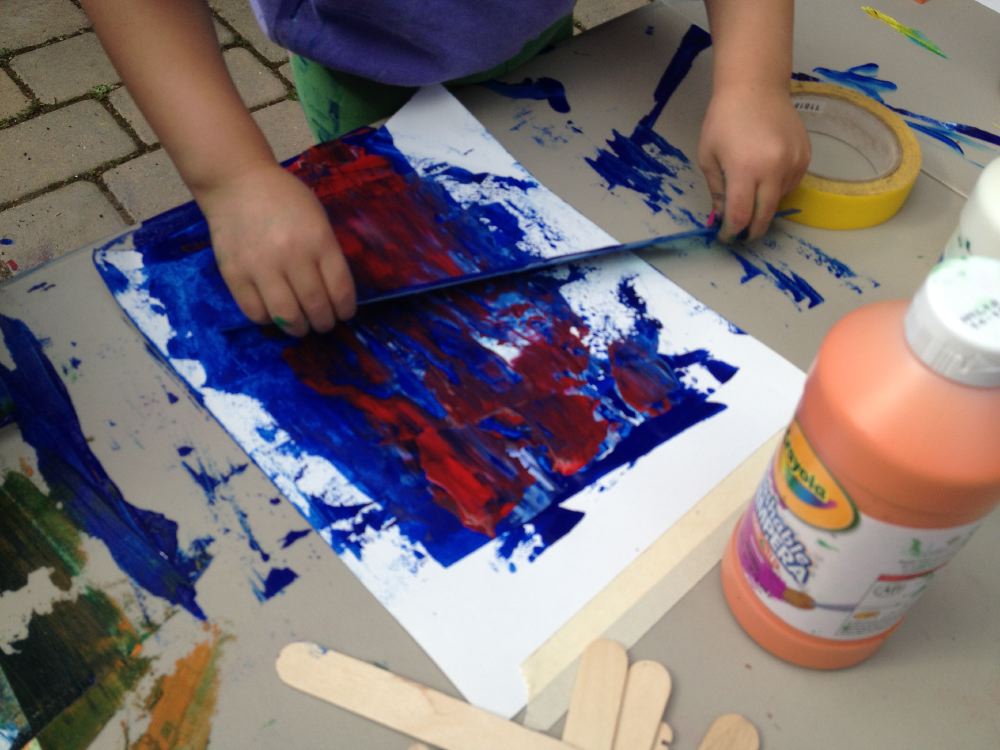
We used Teacher Tom’s idea about using popsicle sticks, but we made ours in square frames, and wrapped a rubber band around so that it went in a triangle along the frame and across the middle. Then paint the rubber band and SNAP with your fingers! (Rebecca is holding the frame right against the paper in the above picture, but it works better if you hold it a couple inches over the paper so the paint has room to fly out. It makes the most interesting squiggly trails of paint! Very messy, there’s a lot of back-snap, the paint doesn’t all go forward! But at least the kids we have obeyed the injunction not to chase each other around snapping paint… YMMV!

Pendulum Painting

Friday, August 5th, 2011

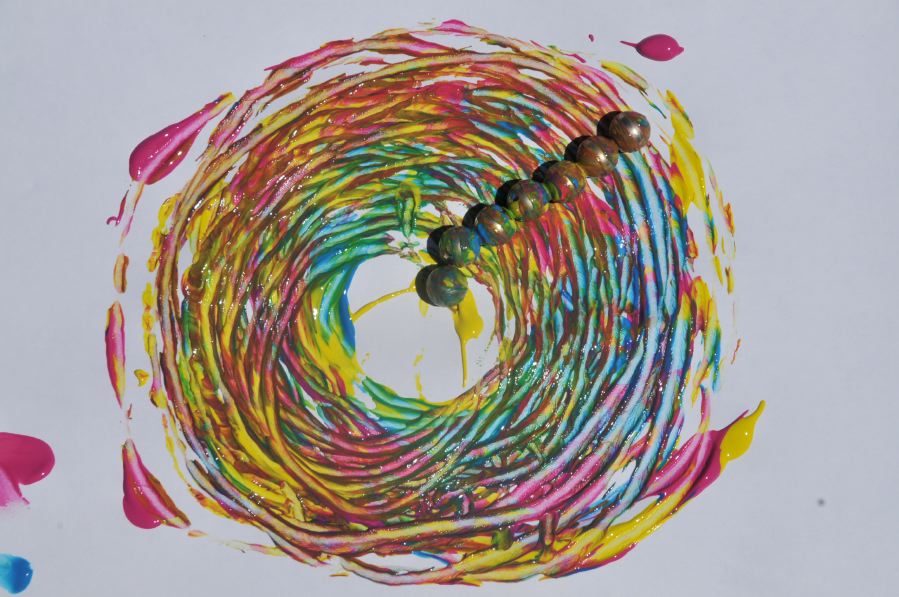
Art Friday, the slightly late edition. This is a good one though, although it’s more work to set up than many. But, it’s physics! It’s paint! It’s fun!

Woo pendulum painting! I saw this idea in Disney Family Fun Magazine, and also in Teacher Tom’s blog. Disney had you hang the pendulum from a tree, Teacher Tom had built a pvc table frame.

I didn’t have paper big enough for a tree-hung-pendulum, and if I had used one I know a few young ladies that would have swung the pendulum over their heads spraying paint all over the visible scene. I also didn’t have enough PVC to build a dedicated frame, but I did have several 5′ lengths that I’d just bought for our air rocket project. (Yes, there will be pictures of that next Friday.)

So I used my mad lashing skills to make a tripod. We should all get to use our mad lashing skills more often, I am pretty sure.

Our pendulum we made out of an 8oz paint bottle with a glue bottle type nozzle. My original thinking was that we would be able to control the flow, but it only barely worked full open. It did make it easy to close it to fill with paint though.

For the paint I just used tempera paint cut 50/50 with water. I kept adding water until it would freely drain through the glue bottle cap. Sometimes I didn’t add enough and it would make a drippy spotty line, but that’s fun too.

We all had fun! There was ‘proper’ painting by letting the pendulum swing, and also quite a lot of just holding the string and wagging the pendulum around, in addition to some ‘moving the paper’ techniques employed by our youngest artist.

If I was going to do it again I would mix up a big pitcher of a single color (or maybe two) and precut the paper, because I felt like set up was a big bottle neck to our creative exploration. Also, bigger paper.

Or, you know, we could go totally hard core like this artist, Tom Shannon, and build a radio controlled solenoid driven six color mixing monster pendulum. But we probably won’t. At least not this year.