Posts Tagged ‘food’

Brown Rice Onigiri

Monday, June 1st, 2009

Onigiri

This is cheating, but if you like to make rice balls, and you like to only cook with brown rice, if you just can’t make them sticky enough, I had an epiphany. I’m sure other people have discovered this before, but I’m still going to enjoy my mischievous flash of brilliance. What is sticky and made of rice? Mochi! What is the easy way of making mochi? Using mochi/rice flour and microwaving it with water and sugar and flavoring. What happens when you add a little mochi flour to the brown rice along with the soy sauce/vinegar/ponzu sauce/sugar/salt/whatever for your rice and then microwave it to make it hot? It gets sticky! Is this cheating? Of course. Does it work? Yes! So now I can make brown rice onigiri that don’t fall apart. Just add a sprinkle of mochi flour to your rice when it is hot and you are mixing in everything else. Magic sticky rice glue.

Chocolate Peppermint Creams

Thursday, February 12th, 2009

Dipped Hearts

I didn’t make anything last week. Bleh. We’ve been going to pre-school open houses constantly it feels like. I wanted to be one of those cool homeschooling moms who lives in the middle of nowhere and has a farm, but my daughter has been asking me whenever we see a bus or a school playground when she can start school, so obviously that isn’t her plan, and I feel like I should respect that. So we’re looking at parent-participation pre-schools. And I don’t live in the middle of nowhere and I don’t have a farm, I have a teeny garden, but that’s beside the point. We did pick a whole pile of February carrots and eat them for lunch on wednesday though. And we watched bugs. Digression.

Carrots

This week, about the best I can share is the Valentines Day candies we made. (We’re working on some paper-pulp play pizzas, (that’s what’s in the oven baking behind Rebecca) but those are going to be Rebecca’s mess in the end, not mine.) Someone linked to flossie teacakes peppermint hearts recipe which is great. Rebecca mixed the whole thing up. The ‘medium sized mound’ of powdered sugar turns out to be about half of one of those ubiquitous boxes. And we added way too much peppermint essence, about half a teaspoon. That made them awesome like Altoids. My addition, you need to dip these in dark chocolate. Oooooooooooh yah. Since they are solid sugar, the bitter-er the chocolate the better, I think. Do they make chocolate dipped Altoids?

Cutting HeartsDipping Hearts

Phonics Miniatures Swap

Saturday, January 31st, 2009

I’ve been much too busy recently, trying to find time for my ‘real’ job, the one I get paid for to work occasionally, and also trying to finish Jo’s phonics swap. Which I did at the last minute today, squeaking into my post office ten minutes before it closed. Sort of like how I joined the swap, two days late, luckily scoring another late mom, Schelle, for a swap partner, and then Anne of itty bitty love took pity on me and added me as an extra swap partner. Lucky me! In the mean time I’d agreed to do 15 items with Schelle since we only had one partner, and we did a full-disclosure swap so we didn’t get any items we already had, that made it trickier too.

My plan going into these is always that I will make three of everything so I have one for my daughter too, but I fell behind a little bit on this one. We’ll see if I manage to go back and make it up.

Here are the things that I made, rather than bought:
Small Things

Tiny quilts with 1/2″ patches, one of them with an ‘I’m lazy’ experimental zigzag stitch for binding and one with an honest binding (I hate binding quilts, it is by far my least favorite part.) My daughter did the packing, deciding which of paired objects went to the little boy, and which went to the school, that’s almost as good as rolling dice, right? I think these came out pretty well. They are pushing up against the 10cm size limit though, perhaps I should have done smaller.

Wool felt embroidered hearts, for H, but they could go for E for embroidery too. This is something that I can work on while walking down the sidewalk following a two year old on a tricycle. That’s one of the great things about tiny hand sewing projects.

Books. I got the pdf for these from the Internet Archive, ‘Funny Alphabet’ which is a great source, they have other ancient alphabet books there too. After getting the pdf I spent two hours swearing at pdf munging tools and my printer, trying to get the pages properly interleaved and duplex printing lining them up right. And here I thought it would be simple… I have vague memories of creating a tiny Alice in Wonderland book, I still have it, the book is real, about one inch tall, the creation process is vague, but I think the main difference was I started from text, and used postscript and nup rather than pdfs… and a ‘real’ duplex printer. But enough about that. They came out alright in the end.

Then there’s velvet for V, which I hemmed with lace, I’m not sure I really like how that came out, it’s a bit crooked and fussy, and plain cotton lace for L, both of which Schelle vetoed because she had plenty already. Maybe Anne does too, but we didn’t exchange item lists for vetoes. And okay, I didn’t really make the lace, I just put tape on the ends. Last swap I made little lace boards with three different kinds of lace, but I decided that having a larger single piece of lace you could see through was more tactile and satisfying.

Olives, I think this is the right Montessori phoneme for O, I have trouble with remembering which vowel sound is the primary one, I need to print out a list. Like for I you are ‘supposed’ to use the short ‘I’ sound like ‘in’, not the long ‘I’ sound in ‘ice’. Are they all the short vowels? My phonics partners in the past haven’t been too picky, and I probably need to take another look at my boxes, because that can make it confusing to mix the sounds. I suppose I should separate them out and make long vowel boxes too? I am obviously not Montessori trained like Anne and Jo.

Anyway, the olives I made out of fimo, and they were the perfect olive color before I baked them and they darkened. :-( And then I did a bad job using ModPodge to make them glossy, (I used a coarse brush and they came out quite ridged), before spraying them with acrylic glaze which sort-of fixed things. Maybe these fall in the un-lovely plastic category. Most of the time I’m so crunchy, and then I find myself baking fimo in the kitchen, thinking, what am I doing. And then I go and sand it, which is worse, but at least I was doing wet-sanding, that helps a lot with the not breathing poison thing.

Moving on to the kites for K. They are just paper around cardstock, with embroidery floss tails. Turns out Schelle was going to make me a kite too, so we both dropped that, but Anne still got one. Rebecca really likes these, so I’m not sad we have an extra. I found one outside on the sidewalk, so we may not have two for long. I need to get these things into her phonics boxes before she plays them to death.

Ravioli for R, felted acrylic with cotton batting filling. You’ve seen this before.

Washcloths for W, I knitted these out of striped cotton, another following the tricycle craft. The first one I knit on bamboo size 0 needles, which was no fun, because they kept bending rather than doing what I wanted, probably because the yarn was too heavy for them. The second two were knit on size 3 metal needles and there was far less hair pulling. They are hardly any bigger either, because of the weight of the yarn. Perhaps washcloths should be terry cloth in the modern world, but I like these.

Jump ropes for J, these are super tiny, made with pearl cotton and seed beads for the handles. I glued the knots so they would stay. I wasn’t sure these would read as jump ropes, but a friend of mine thought they were perfect so I have more faith now. I hope they don’t get too tangled.

And last, an oar, for O. I got the idea to make this from going through my years (99-03 I think) of Dollhouse Miniatures, otherwise it never would have occurred to me. This one is a long O and fills one of Schelle’s vetoed spots, so I only made one.

I did buy a few things too, and a few things I had left over from buying sets or getting duplicates from the first phonics swap, a tiny terra cotta pot, spring, switch, rolling pin, lady bugs and paper umbrellas. Oh, and a 50 yen coin. Mostly for Schelle’s 5 extra spots. (I’m sorry I meant to stick a yen coin as an extra in your package Anne, but I forgot!)

Things I meant to make but didn’t, pillows, underwear, masks, a house… other things on my list, a leaf in contact paper, a diaper, ornament (but that is a long O again), a chain… Once I get my phonics swaps in the mail I’ll see where the low spots in my alphabet are, and prioritize those for making. Schelle was great about targeting the list of my weak letters that I gave her, and I half did too, so now I have to see if any of them have turned into strong points.

I’m rambling. Anyway, maybe at some point I will be able to claim that I’ve crafted the whole alphabet. :-) What do I have left? c,e,f,g,i,l,m,n,p,s,t,u,z – half way there!

Felt Tomato Slice Tutorial

Thursday, January 1st, 2009

Tomato 1 Heirloom Tomato

Step 1: Research! (actually step 0 was make a bad tomato I think…) Have you ever really studied tomato slices before? They are surprisingly not that symmetric. Do you slice your tomato through the stem? I slice mine through their equators. If they are squatty tomatoes. If they are lumpy heirloom tomatoes I cut them in chunks and them slice them any which way. I had a point somewhere. It was that tomatoes look so many different ways that you have a lot of freedom to play with the inside shapes. Don’t think there is some ‘right’ tomato slice or that they have to be perfectly symmetric.

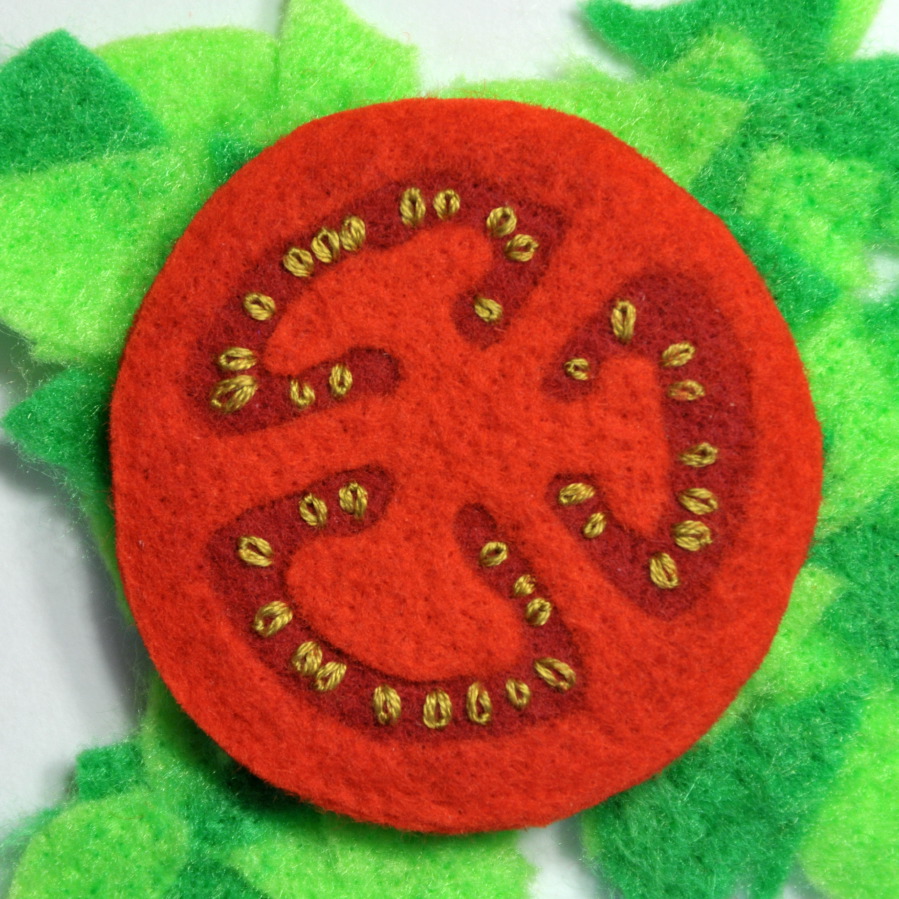
I did make some funny looking tomatoes that no one could tell what they were… so there *is* room for bad tomatoes, but there’s a lot of leeway. And you could tell what they were if they were part of a sandwich set, but the first guess was ‘flower?’. I originally made the flesh red and the pulp pink and I left out the seeds. They were okay, but not very convincing I guess. The pulp of a real tomato is actually darker than the flesh, and the seeds seem to be pretty important. Here’s what I finally came up with:

Finished Tomato

This tomato only uses two felt colors, if you wanted to go for extra realism you’d have to make the mushroom-y bits that the seeds stick to a lighter color than the rest of the flesh. [There's an example of that at Akiyo's amazing gallery in the lunch section. If you want to read the text you can use Google's translation, it works pretty well.] But since I was needle felting the whole thing together I didn’t want to deal with the overlapping and shrinkage calculation of two ‘top’ layers, and I didn’t want them to overlap. Onward.

Tomato circles

First cut out four circles, two large circles in the tomato flesh color, and two pulp colored circles 1/8″ smaller all around. If you want perfect circles you can trace a drinking glass or something, but tomatoes aren’t really circles anyway, so just cut them out freehand. Mine are pretty lumpy, aren’t they! But I trim them at the end.

Do make sure the two large circles are the same shape, and once you have everything cut out and lined up, mark the circles near the edge so that you can line them up again. While they are lined up mark one on the front and one on the back, one on each side so that you can put the marked sides inward and you won’t see them on the finished tomato. (Or use a water-erase marker, I -shockingly- just used a permanent marker.) Mark the smaller pulp pieces in the same spot too. You want to be able to put the whole stack together so they fit neatly. If you do cut out perfect circles then you can skip this step, because they will line up no matter how they are turned.

Cut Flesh

Next cut out holes in the larger tomato flesh circles for the pulp to show through. Decide how many holes you want, 3,4,5… then use a pen to divide the circle into sections and draw a C shape for the pulp hole into each of them. Make sure to leave a 1/4″ border around the outside of the circle with no holes, so that it will overlap by 1/8″ with the pulp circles. Otherwise you will have a hole through your tomato. Cut out the marked holes with a sharp pair of scissors. Once you cut out one side you can match it back up against the other large flesh circle, marked sides together, and use it as a template to mark the holes for the other side. Then cut the holes in the second tomato flesh circle.

stacked tomato

Put together each inside pulp circle with one cut out flesh circle, lining the marks up. (You should have two pairs, don’t put the whole thing together yet.)

Felted down halves

Either needle felt the flesh cutout to the pulp circle or use a running stitch or applique stitch around each of the cut out holes to join them together. Or, heck, you could use fabric glue if you’re in a rush. I needle felted mine.

Seeds

Now that you have two hopefully solid tomato sides it’s time to add the seeds. Scatter them around, try not to space them too uniformly. I used two methods here, lazy daisy stitches in an ochre thread and green-on-the-inside clear seed beads. I’m not sure which I like better, what do you think? Looking at them now I think there are too many seeds and they are too small, but some varieties of tomatoes have lots of small seeds, so that’s okay. (^_^) I think it would also be interesting to try painting the seeds on with acrylic craft paint, but that might be more likely to be eaten off? I haven’t tried painting felt yet, I’ll have to add that to my imaginary list. Does acrylic stick to wool felt, or do you have to use acrylic or polyester felt? Questions to research.

Finished Tomato

After you have your seeds on line your tomato sides up back to back so that the flesh patterns match up. At this point you can needle felt them together, being careful to only go through the flesh sections so you don’t mess up your embroidery or break a needle on your beads, or you can stitch them together around the edge. After you felt them or before you stitch them trim around the outside edge to neaten it and make sure the two pieces line up perfectly.

Yum! (And am I glad to be done, this tutorial took forever to write up for some reason, and I’m not that happy with the pictures, I really had to force myself through this one and not wait for nice light. But moving on into the new year, let’s be more positive.)

So what do you think, embroidered or beaded seeds?


Felt Lettuce Tutorial

Thursday, December 11th, 2008

I bought a loaf of Haba Biofino Bread (they call it toast actually but I have no idea why, there isn’t anything toast-like about it) as a present for a little girl, and I wanted to make some sandwich bits to go with it. First, lettuce.

The bread is about 3″ across, so I started with a 3″ square and sketched a romaine-ish lettuce leaf. This is actually my second sketch, the first was to ruffly, and when I free-hand cut it out with scissors this shape is closer to what I got. So I revised my pattern to match what I had cut. Thus my cutting became correct. Hrm. :-) That’s how I make my patterns anyway.

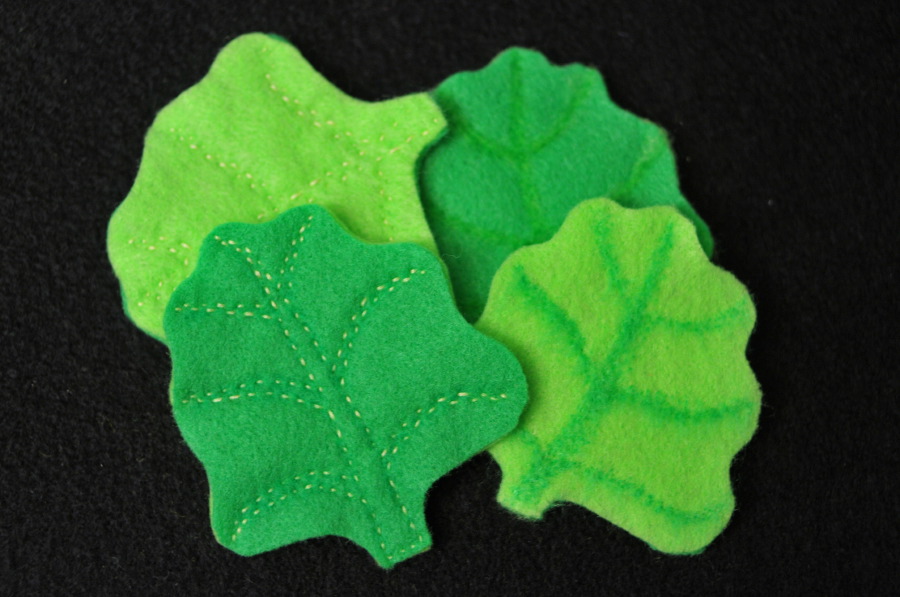
So, take two felt squares 3″ across, I like mine contrasting, so the lettuce is different colors on the front and back, but you could make them the same color if you want, or you could be daring, and just use one square. Depends on how delicate your felt feels, and the age of its intended audience. You need two contrasting colors for the felting method, if you are going to embroider you can use one or two of matching or contrasting colors.

Put the squares back to back if you have two, and cut your leaf shape. You can print my pattern out, scaling it however you want, but I like all my leaves a little different, so I just freehand it. Whatever shape you cut out, I’m sure there is a lettuce leaf somewhere in the wide world that looks just like that, you are perfect!

Method 1: Embroidery

Mark the rib outlines with a chalk pencil or disappearing marking pen. I tried skipping this step and it didn’t come out how I wanted at all. (I’m a big fan of skipping steps.) Notice that the rib patten I drew on the pattern above is one continuous line, going out along each branch as you come to it. If you follow that line with a running stitch it looks nice from the front or the back, there won’t be any crossing stitches on either side. Pick a contrasting color for your embroidery. Red! I’m going to have to make my next one in red! And maybe I’ll change the leaf shape a little bit to be like that red veined yummy spinach stuff in the farmer’s market salad mix. Mmmmmmm.

Start your running stitch in between the leaf shapes, and leave a long tail behind your knot. That way when you get back around to the beginning you can tie your ends together and hide the knot inside. To do this you need to start somewhere that isn’t too close to the edge of the felt (i.e. don’t start at the bottom of the stem which is the natural place to start…) Or you can just tie off however you want.

Method 2: Felting

I’ve become a total needle felting addict. And that makes this project really fast and simple. Just sketch your rib lines onto the leaf with a chalk pencil or whatever, and go at it with a needle felting pen. Felt along your lines from the front and the back a couple times, and magically the contrasting color will show through on each side. If you have the right kind of felt. My light color on these leaves actually didn’t show up against the dark green, I think it was too transparent, because I used acrylic felt. I haven’t had that problem with wool felt. Since the dark side didn’t have enough contrast I ‘fixed’ it by adding some veins on with a fabric pen. It isn’t cheating if it’s art. Maybe that should be my new motto. :-D I wonder how to say that in latin?

With either method you can fluff up your leaf by sticking your finger in between the ribs and pulling the sheets apart a little. And maybe giving it a good crumple depending on how sturdy it feels.

I hope this is helpful to someone, let me know if you make yourself a salad or some sandwich fillings. Next on my list are tomatoes, cheese, and bread. The bread is the hard part, I think. I was going to skip it, but I’ve been doing some experiments. I couldn’t help it.


Felt Farfalle (Bowtie) Pasta

Monday, November 24th, 2008


More playfood, this is ridiculously easy to make. You may notice that the finished pasta is a different color than the in-process pasta… My daughter broke my last felting needle while I was wraping the second-to-last felting needle that I had just broken in tape to throw it away… Oy. Her punishment was having to go to the (boring) quilting store to buy me new felting needles. (^_^)

Cut a felt rectangle 1.5" by however long you want.  Each inch of length will make one pasta.

Cut a felt rectangle 1.5" by however long you want. Each inch of length will make one pasta.

Pink the long edges of your rectangle.

Pink the long edges of your rectangle.

Cut into approximately 1" wide sections.

Cut into approximately 1" wide sections.

Fold felt into a W the long way, and needle felt or stitch in the middle.  Don't felt it too much or you will thin the felt and it will rip.

Fold felt into a W the long way, and needle felt, stitch, or heck, glue, in the middle. If you needle felt, don't felt it too much or you will thin the felt and it will rip.


Done! Wasn’t that easy? And aren’t they cute? I don’t know how well they’ll hold up to a playful two year old, I’ll have to wait and see…